
If you’re designing power systems for airborne platforms, you’ve almost certainly encountered both MIL-STD-704F and RTCA/DO-160. They are often mentioned together, but they serve different roles. Comparing them too broadly can blur where each applies and lead to avoidable redesigns, qualification setbacks, and program delays.
MIL-STD-704F is centered on the aircraft power interface. DO-160G is broader, covering many aspects of airborne qualification, with Section 16 addressing power input quality.
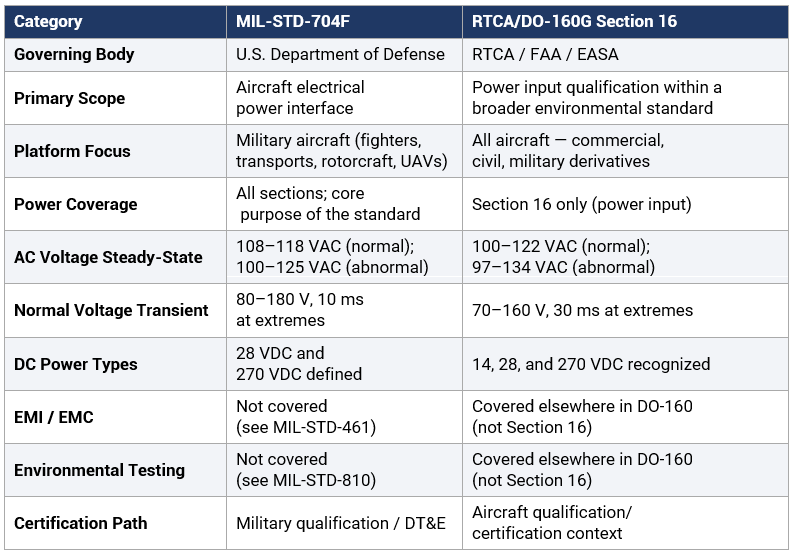
Since that is where the two standards address the same issue most directly, Section 16 is the closest point of comparison to MIL-STD-704F. Other DO-160 sections align more naturally with other MIL standards, including MIL-STD-810 for environmental conditions and MIL-STD-461 for EMC-related requirements.
What This Comparison Actually Covers
MIL-STD-704F defines the electrical power interface between a military aircraft’s power system and its onboard utilization equipment. In practical terms, it sets expectations for steady-state voltage, abnormal conditions, transients, frequency ranges, and emergency power behavior, and establishes what airborne equipment must tolerate and continue operating through.
RTCA/DO-160G is a much broader environmental qualification standard published by the Radio Technical Commission for Aeronautics. It covers temperature, altitude, vibration, humidity, EMC, lightning, and much more. Within that broader standard, Section 16 addresses power input quality directly.
MIL-STD-704F looks specifically at the aircraft power interface. DO-160 takes a much wider view of airborne qualification, and Section 16 is the part that speaks directly to power input. That is why Section 16 is the closest point of comparison here.
MIL-STD-704F vs. DO-160 Section 16 at a Glance
Why This Distinction Matters in Real Programs
In many airborne programs, military and civil-derived requirements overlap. Government transport aircraft, ISR platforms, and advanced UAVs may be asked to satisfy MIL-based platform requirements while also aligning with broader aviation qualification expectations. That is why teams often need to look at both MIL-STD-704F and DO-160 Section 16 during design and verification.
This is also why several Enercon products are designed with dual-standard support in mind. The M4054 - our rugged, SOSA™-aligned 3U VPX DC-DC power supply - offers a DC input range of 18-50V, with designs aligned with both MIL-STD-704 and DO-160 requirements, and variants supporting wider ranges for allied nation compatibility. The M9538 airborne power distribution unit similarly complies with MIL-STD-704F, DO-160G, and EN2282, making it suitable for a wide spectrum of airborne platform types.
Where the Differences Matter Most at the Test Bench
When the comparison is limited to power input, the differences become clearer. DO-160 Section 16 allows a wider abnormal voltage range (97-134 VAC vs. MIL-STD-704F’s 100-125 VAC) and a longer transient duration at extreme voltages. That means a power supply designed to MIL-STD-704F will often be well-positioned for DO-160 Section 16, but the reverse is not always true. For programs that need confidence across both requirement sets, it is usually smarter to account for both from the start rather than treat one as a late-stage add-on.
Products Designed for the Overlap
At Enercon Technologies, our engineering approach is not to treat these standards as rivals, but to identify the areas where requirements intersect and design accordingly. That helps programs support military aircraft power expectations while staying aligned with the relevant airborne qualification framework.
• M4054: Rugged, SOSA™-aligned 3U VPX DC-DC PSU | MIL-STD-704, DO-160, MIL-STD-810, MIL-STD-461
• M9538: 8-Channel Airborne Power Distribution Unit | MIL-STD-704F, DO-160G, EN2282
• M2705: 3-Phase AC-DC Power Supply | MIL-STD-704, MIL-STD-810, MIL-STD-461
• M7525: DC-DC Converter, up to 800W | MIL-STD-704, MIL-STD-1275, MIL-STD-810, MIL-STD-461
Final Takeaway
Because DO-160 covers far more than power input, it is better understood as a broader airborne qualification standard than as a direct counterpart to MIL-STD-704F. For this discussion, Section 16 is the relevant point of comparison, while other DO-160 sections align more naturally with standards such as MIL-STD-810 and MIL-STD-461.