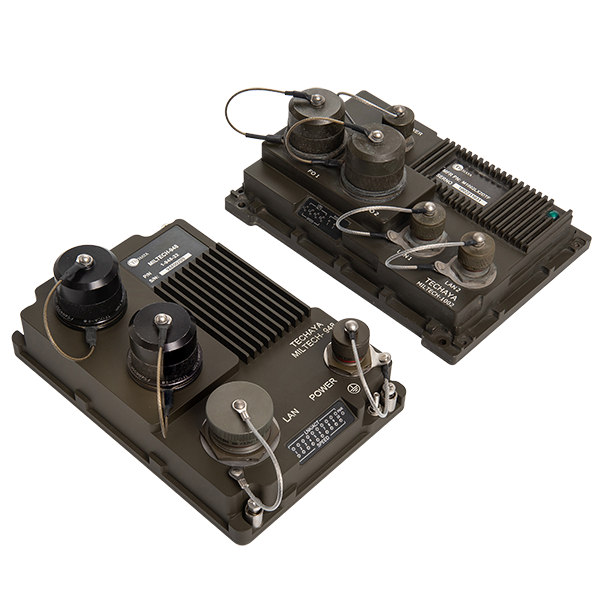
Enabling flexible interconnection between diverse network, control, and I/O interfaces in rugged environments.
The MILTECH 1000 and MILTECH 1100 series enable rugged 1G/10G copper‑to‑fiber Ethernet conversion, extending LAN distances over multimode, single‑mode, or WDM fiber, and optionally incorporating Power over Ethernet (PoE) to deliver both data and power over a single cable, simplifying system architecture, reducing cabling weight, and supporting remote edge devices. Beyond Ethernet, the Media Converters portfolio supports multi‑connectivity platforms by providing dedicated conversion and expansion for multiple interface types, including legacy serial (RS232/RS422/RS485), USB, VGA, and discrete I/O communications. These solutions enable simultaneous connectivity between legacy equipment, sensors, displays, and mission computers, allowing dispersed subsystems to be consolidated into centralized or distributed processing architectures while maintaining reliable operation in rugged military environments. Designed for harsh environments and high reliability, the media converters are developed to suit frontline forces operating in the most complex modern battlefield scenarios and meet military standards such as MIL‑STD‑461, MIL‑STD‑810, MIL‑STD‑1275, and IP67/68.
Need Custom Solution?
For all your requirements, we’ll custom design a solution to fit your needs
A media converter is a device that enables communication between different network media types, such as Copper and Fiber optic connections. In aerospace and defense environments, media converters improve long-distance data transmission, reduce signal interference, and support secure, high-speed communication in harsh operating conditions.
The media converters support multimode and single mode fiber at 1G and up to 10G depending on the model, with WDM (single-strand bidirectional) as an option. Single mode links reach roughly 30 km per the fiber option tables, and the line as a whole extends LAN distance well beyond copper limits. The exact fiber type, speed, and connector are selected through the ordering code, so define both fiber ports (and copper port count) when you build the part number.
Yes. They are orderable as non-PoE, as a Powered Device (PD) that draws power from the network, or as Power Sourcing Equipment (PSE) that feeds downstream devices, with support for 802.3af, 802.3at, and 802.3bt including higher-wattage budgets. This lets one unit power a camera or radio in the field without a separate supply. Confirm the PoE budget and standard on the specific datasheet, since it differs between the PD, PSE, and non-PoE variants.
USB to Ethernet is supported on Windows, Linux, and Android, and USB to RS232/RS422/RS485 is supported on Windows and Linux. The Ethernet-to-serial (terminal server) direction is supported on Windows, with Linux on the roadmap for some models. Some USB units also provide USB Power Delivery charging to keep a connected tablet or laptop powered during operation, so check the OS and power-delivery notes on the model's datasheet.
Serial ports across the line handle RS232, RS422 (full duplex), and RS485 (half or full duplex depending on the unit), including RTS and CTS handshaking. Some units expose these as multiprotocol ports, while others ship in a fixed configuration set by the part number. Check the physical ports section of the datasheet to see whether a given port is switchable or fixed and request the ICD from the factory for signal-level pinout details.
Discrete I/O is provided as Open/Ground and, on some units, Open/Power inputs and outputs, and the fiber communication system provides opto-isolated (galvanically isolated) discrete channels. Typical configurations offer several GPI and GPO lines per unit for controlling or monitoring legacy equipment. The exact channel count, direction, and whether they are isolated is listed per model, so confirm against your load and voltage requirements before specifying.
Yes, several products are built for this. The serial and I/O terminal servers can run in a back-to-back bridge mode over Ethernet so serial and discrete signals appear transparently at the far end, and the fiber communication system transfers video, serial, discrete I/O, and Gigabit Ethernet over a single tactical fiber between a transmitter and receiver. Serial-over-USB units can also cascade multiple devices to expand port density on one host. The datasheet for each product describes the supported topology and any pairing requirements.
It depends on the product. The media converters are generally unmanaged with DIP-switch settings for auto-negotiation, speed, and features like fiber-loss link shutdown or port segregation, plus optional remote management. The fiber communication system includes a fully managed SNMP and CLI Gigabit Ethernet switch, and the terminal servers allow fixed IP and per-port assignment. Check the networking section of the specific datasheet to confirm the management model.
Each datasheet includes outline drawings, connector part numbers, and mounting details useful for early integration planning. For a full Interface Control Document (ICD), detailed pinouts, or test reports, contact the manufacturer directly at [email protected] , as these items are not published in the datasheets themselves.
Enercon Technologies Ltd.
P.O.B. 13011 27 Yad Harutzim St., Siim Park, Bldg. 5 Netanya, 4237901 Israel
P: +972-73-2469200
This email address is being protected from spambots. You need JavaScript enabled to view it.